
It began on a warm, sunny spring day, many years ago when I was conducting research on the effects of Reiki at a large University. The two young doctors had come to me with a unique problem they were encountering in the ICU. As new life sprang up around us in a riot of flowers, these two young men explained the very darkest aspects of their work. The long hours, the toil in the face of death, because with the very sickest patients, that’s where it usually ended up. The brutality of the final resuscitation code, the beating on the dying patient administering CPR, the alarms sounding from the machines, the unending futility. And yet, something else was happening that was outside anything they had been taught. Immediately after a particularly rough “code”, they both always saw the same thing—a luminescent haze or mist that escaped the dying patient’s body and roamed around the unit for a few days, sometimes a week or two, then disappeared. Both had a suspicion that these were the lost and confused spiritual entities of their patients and that they had no idea where to go. They asked me, what were they, as physicians, supposed to do? It became clear that this was not the end of their healing journey, and that they needed more instruction as to how to handle these lost patients.
My bioenergetic healing experience with Reiki and my work with the dying taught me that such journeying is possible (Rubik, 2017). I also trained with a practitioner who utilized transformative trance practice in healing work. Interactions such as the following case are not isolated (Peters, 2020).
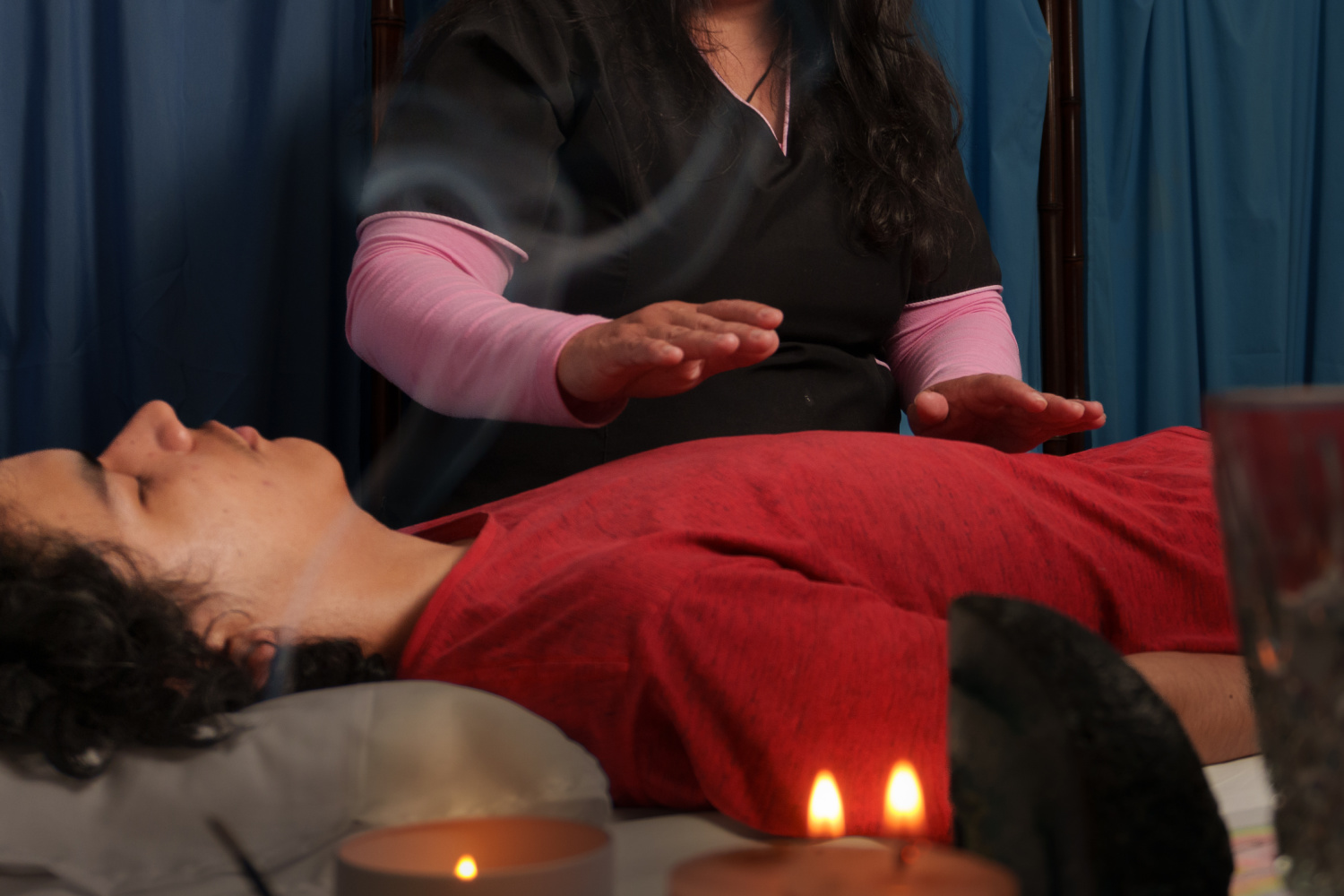 The role of the psychopomp, the escort of the dying to their destination, has only recently been rediscovered within the Western world. Yet many religions and spiritual paths over centuries have still retained prayer and rituals intended to guide the dying to their next level of consciousness (Morrill & Rodgers, 2006; S. Rinpoche, 1994).
Humans still respond to cultural imagery and the innate ability to attain various levels of consciousness through symbols and ritual (Comas-Diaz, 2016; Facco et al., 2015; Laughlin et al., 1990; Noel, 1997; Winkelman, 2000, 2002, 2010). For example, meditation offers access to other levels of consciousness, as does the trance state in Indigenous spiritual practice. Throughout the written history of a wide array of cultures, a thread weaves through it of the abilities of the psychopomp, the liminal traveler of worlds, escorting those transitioning to the next reality. It may be time to examine how these common attributes and practices may benefit our patients now in the modern hospital setting.
At the hour of passing, our patients need us no less than when they are deep in the throes of their illness. We do our best to heal them, but there comes a time when surrender becomes necessary. Why would we not use all the available tools to help them through that final door?
I was impressed with the young physicians’ observations and the purity of their compassion for their dying patients. Their schedules prevented me from teaching them in depth, but I gave them some basic instructions in holding a sacred space and directing their lost patients’ spirits to the next level of life. Chaplaincy addresses this work to some degree; their work is invaluable, but patients trust their primary practitioners and are greater satisfied with treatment when asked about their spiritual beliefs by them specifically (Williams et al., 2011). This could lead to an overall lessening of anxiety and a greater continuity of care if they could openly discuss transition and assure their patients that they also can be active stewards of that process with them.
On Her Own
One of the new hospice patients where I volunteer, A., needed a patient sitter. A. had suffered a cardiac arrest. She was admitted to the ICU from the Emergency Department, then transferred to hospice, as her extensive brain damage indicated that she would not recover. Her nurses had asked for a sitter as A. was anxious and short of breath. She was in distress and sweating heavily from working so hard to breathe, but not fully conscious. The physician managing her care came in and ordered medication for anxiety, which did not help her, her restlessness continued unabated.
Since patients can hear even if they are not fully aware, I introduced myself to her. She was not close to passing immediately; her face was flushed, her extremities were cold and pallid but her heart rate was still fast and thready. It was clear she was agitated and fearful. Kneeling down next to her bed, I explained to her that she had experienced a cardiac arrest and that she was now in a hospice and about to leave this level of consciousness for the next. She opened her eyes wide for a moment, grimacing, then regressed to half-open eyes and labored breathing.
 I told her that I had experience walking across the threshold with people as they passed over to the next plane of consciousness and that there was nothing to be afraid of, and transition does not hurt. That she was not dying, and she is immortal, and it is a myth that people must do this alone. I told her to remember my voice and to call out to me in her mind and that I would hear her, and I would come.
The following morning, I immediately felt upon waking a significant mental push to go into meditation, as her voice or intention was in my mind so intensely, I could not focus on anything else. Quickly, I accessed an altered state of consciousness. I could hear her, she was terrified. Immediately in my trance state, I was at her bedside.
“I’m here, A., I’m here….” I repeated what I had stated the day before, “It does not hurt, A., you’re going to be OK.” In my mind’s eye, I could hear and feel her howling in fear. I called to Jesus to come and receive her, I thought that he would be the spiritual figure that she would be the most familiar with. An older lady appeared; I perceived a “Grandmother” energy from her. I found out later from A.’s obituary that she had a grandmother who had already passed. I told her that she did not need to resist anymore. I visualized her leaving her body; Jesus was standing next to the bed, and I handed her off to him. He took her up in his arms, and they left together. I then came out of my trance state and noted the time, 12:30 PM. After a few minutes, I emailed the hospice and asked how A. was. When I heard back, I was told she passed at around 12:30.
Where to From Here?
The name “psychopomp” translates as “leader of souls” from the Greek and refers to a guide of the dying from the lower worlds to the higher levels of consciousness (Bryan, 2013). While some practitioners retain rituals related to Indigenous practice, the cultural origin of the tools used to empower intention and the person being acted upon is essential only to the practitioner (Bryan, 2013).
The door is cracking open to other ways of knowing (Comas-Diaz, 2016; Facco et al., 2015). The Buddhist view, among others, is that information drawn from visioning is just as valid as information collected in our consensus reality (G. Rinpoche et al., 2003). Multiple Indigenous spiritual paths practice such transformative work as described here. Although practices vary based on cultural perspectives (Walker & Fridman, 2004), it is essential to recognize that the various viewpoints all incorporate this numinous space in life. Anecdotal evidence over centuries suggests additional dimensions exist past our presently recognized perceptions.
Rather than think of these as rare or abnormal gifts, the history and tradition of the psychopomp suggest that this profession has a long, continuous history. The driver of this process is our compassion and intention. These intentions and their accompanying rituals have been documented in Catholicism, Buddhism, and many Indigenous spiritual practices (Coberly, 1997; Lodo, 1982; Morrill & Rodgers, 2006; Walter & Fridman, 2004). If these abilities are common to many beliefs and traditions, then it is time we recognize that even in the Western medical model, these techniques could have value, even as the young doctors did in the ICU.
We frequently witness the intersection of life and death, but rarely do we as medical personnel openly address the profound spiritual experiences that accompany these transitions. Shared death experiences, which occur when caregivers, loved ones, or healthcare providers witness or participate in a patient’s spiritual transition, offer a contemporary echo of these ancient practices.
We fight for our patients to recover, but sometimes we forget that it is not in our hands which path the patient will take. We can begin to acknowledge truly compassionate dying into healthcare. In doing so, we not only honor our ancestral wisdom but also create space for deeper healing, transforming hospitals into sacred spaces of genuine care and spiritual companionship. Sometimes death is the healing.
References:
Bryan, L. (2013). A shamanic presence in hospice care. In C. Carson MD (Ed.), Spirited medicine: Shamanism in contemporary healthcare. Otter Bay.
Claxton-Oldfield, S., & Yoon, H. (2023). Deathbed visions: Hospice palliative care volunteers’ experiences, perspectives and responses. Omega—J Death and Dying, 0(0) 1-16. https://doi.org/10.1177/00302228231161815
Coberly, M. (1997). Transpersonal dimensions in hospice care and education: Applications of Tibetan Buddhist psychology [Doctoral dissertation, Univ. of Hawaii]. Proquest.
Comas-Diaz, L. (2016). Mujerista psychospirituality. In Womanist and Mujerista psychologies: Voices of fire, acts of courage. APA.
Devery, K., Rawlings, D., Tieman, J., & Damarell, R. (2015). Deathbed phenomena reported by patients in palliative care: Clinical opportunities and responses. Intl Journal of Palliative Nursing, 21(3), 24–32. https://doi.org/10.12968/ijpn.2015.21.3.117
Facco, E., Agrillo, C., & Greyson, B. (2015). Epistemological implications of near-death experiences and other non-ordinary mental expressions: Moving beyond the concept of altered state of consciousness. Medical Hypotheses. https://doi.org/10.1016/j.mehy.2015.04.004
Kowalewski, D. (2019). The Shamanic Renaissance: What is going on? J Humanistic Psychology, 59(2), 170–184. https://doi.org/10.1177/0022167816634522
Lodo, L. (1982). Bardo teachings: The way of death and rebirth. Snow Lion.
Morrill, B. T., & Rodgers, J. E. (2006). Practicing Catholic. MacMillan.
Peters, W. (2020). Shared crossing project. Retrieved March 5, 2021, from https://www.sharedcrossing.com
Rinpoche, G., Fremantle, F., & Trungpa, C. (2003). The Tibetan book of the dead. Shambala.
Rinpoche, S. (1994). The Tibetan book of living and dying. Harper.
Walter, M. N., & Fridman, E. N. (2004). Shamanism: An encyclopedia of world beliefs, practices, and culture. ABC CLIO.
Williams, J.A., Meltzer, D., Arora, V., Chung, G., & Curlin, F.A. (2011). Attention to in-patients religious and spiritual concerns: Predictors and association with patient satisfaction. J Gen Intern Med, 26,(11), 1265-1271. https://doi.org/10.1007/s11606-011-1781-y
Winkelman, M. (2000). Shamanism: The neural ecology of consciousness and healing. Bergin & Garvey.
Winkelman, M. (2002). Shamanism and cognitive evolution. Cambridge Archaeological Journal, 12(1), 71–101. https://doi.org/10.1017/S0959774302000045
Winkelman, M. (2010). Shamanism: A biopsychosocial paradigm of consciousness and healing (2nd ed.). Kindle.
Yin, R. K. (2018). Case study research and applications (6th ed.). SAGE.



Thank you for sharing this subject – very fascinating.
Such an important topic! Thank you, Dr. Gillespie, for the informative and thoughtful article.
A really fascinating insight into psychopomp work and how it can support people transitioning over. I’ve ordered the book – can’t wait to read it. Thank you for sharing your wisdom and experience.